Concentrated knowledge risk
Important behavior and operating history were not captured in maintainable documentation.


Anonymous industrial systems rescue case study
A century-old industrial and logistics business needed to preserve a critical but poorly documented .NET system after essential technical knowledge was no longer available internally.
The situation
The long-established business depended on a custom platform used across industrial and logistics operations. Documentation was incomplete, and much of the system's history was concentrated in knowledge that was no longer available to the organization.
The risk was not tied to one office or one individual event. The company needed a team that could reconstruct how the platform worked, respond to incidents, and create a support model that did not depend on undocumented memory.
The challenge
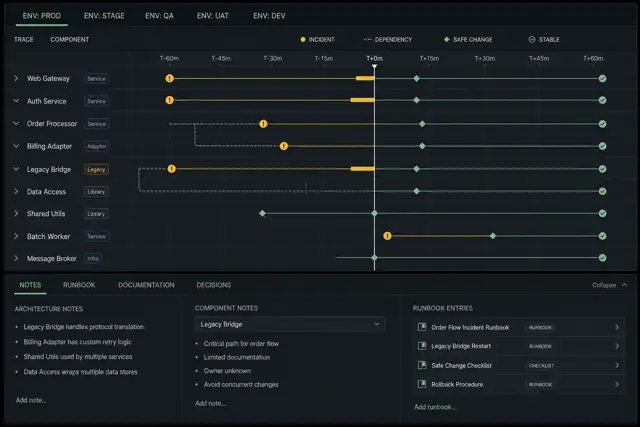
The team had to learn from code, data, logs, users, and connected systems while the platform remained operational.
Important behavior and operating history were not captured in maintainable documentation.
Legacy code and integrations made it difficult to predict the impact of a change.
Support still needed practical response paths while discovery and stabilization were underway.
The solution
The team combined source review, runtime tracing, stakeholder interviews, and controlled fixes to build a usable model of the platform.
Map components, data flows, integrations, schedules, and failure modes from available evidence.
Address recurring faults and add diagnostics where the platform previously failed without useful signals.
Build runbooks, architecture records, release practices, and a support backlog the team could maintain.
How we worked
Discovery work was prioritized around business-critical workflows and recent incident patterns.
Each fix also improved the team's model of the system and added documentation or diagnostics for the next response.
Regular review with operational stakeholders ensured that technical priorities reflected real business impact.
Collect code, logs, data flows, and user evidence.
Document dependencies and critical workflows.
Fix high-risk faults and improve diagnostics.
Maintain runbooks, releases, and long-term support.
The result
The engagement reduced reliance on undocumented history, improved incident response, and created a maintainable basis for ongoing change.
Support no longer depended on knowledge held by a single person.
Traceability and runbooks gave incidents a more structured response path.
The client could plan future changes from a documented understanding of the platform.
Case taxonomy
Recover control of critical legacy software
Get in touch
Tell us what you need to build, modernize, automate, or augment with AI. We can start with a focused discussion or a no-risk 1-week trial.

“A fantastic company to work with.” After the initial rapid development project, American Shipping Co. kept two Shinetech developers embedded for nearly four years, supporting internal and external tools and new AI initiatives.
 CEO, American Shipping Co. - 5-star Google Review